Home › Road, Street, and Municipal Paving
Precision Asphalt Indianapolis provides road paving in Indianapolis, IN for subdivisions, municipal streets, and private developments. Our crews handle new construction and overlays, building smooth, well drained asphalt roads that stand up to traffic and weather. Partner with an experienced paving contractor for your next street or municipal paving project.
Precision Asphalt Indianapolis provides professional road paving throughout Indianapolis, IN, Indiana and the surrounding area. Our licensed, insured crew delivers safe, clean, on-time work with a free estimate before anything begins. Call (317) 793-2897 or request your free quote.
Road, Street, and Municipal Paving in Indianapolis
Precision Asphalt Indianapolis focuses on practical, durable road paving that matches how streets and public routes are really used in and around Indianapolis. We work on city streets, subdivision roads, industrial park drives, and municipal parking and access roads, with a focus on getting traffic back on the surface quickly while still meeting or exceeding local standards.
For public and semi-public roads, the key is pairing the right asphalt mix and pavement thickness with the actual traffic the road carries. A collector street serving older Indy neighborhoods like Irvington needs a different design than a low-traffic cul-de-sac in a newer subdivision or a truck route serving warehouses near I-465. We look at expected vehicle loads, turning patterns, and drainage patterns before we put together a scope and price.
Our crews are used to working in tight conditions, around schools, existing businesses, and residential traffic. We coordinate with property managers, HOAs, and city or county contacts so you know in advance which drives will be open, where temporary parking goes, and how emergency access will be maintained during the work.
How Road Paving Actually Gets Done
For every road, street, or municipal paving job, Precision Asphalt Indianapolis follows a defined process so you know what to expect from start to finish.
1) Evaluation and core sampling: On existing roads, we walk the project, measure distress like cracking, rutting, and potholes, and often take core samples. Cores tell us how thick the current asphalt is and whether there is a sound base underneath. This is critical in older Indy streets that may have been overlaid many times without base repair.
2) Planning traffic control: Before we mobilize equipment, we plan lane closures, flagging, and signage. On municipal or HOA streets we often phase work so residents can still reach their homes. For bus routes or roads serving schools or factories, we schedule paving windows that avoid peak traffic when possible.
3) Milling or removal: If the surface is badly rutted or too high compared to curb, we use a milling machine to remove a set depth of asphalt. For failed streets with base problems, we may do full-depth reclamation or full-depth removal, then rebuild the base. Millings can sometimes be reused on shoulders or temporary access roads.
4) Base repair and grading: We repair soft spots in the subgrade, add stone where needed, and compact it to specified density. In Indianapolis clay soils, this step is critical. If the subgrade pumps under truck traffic, the road will fail early. We also shape the base for proper crown and cross-slope so water sheds to inlets or ditches instead of ponding in wheel paths.
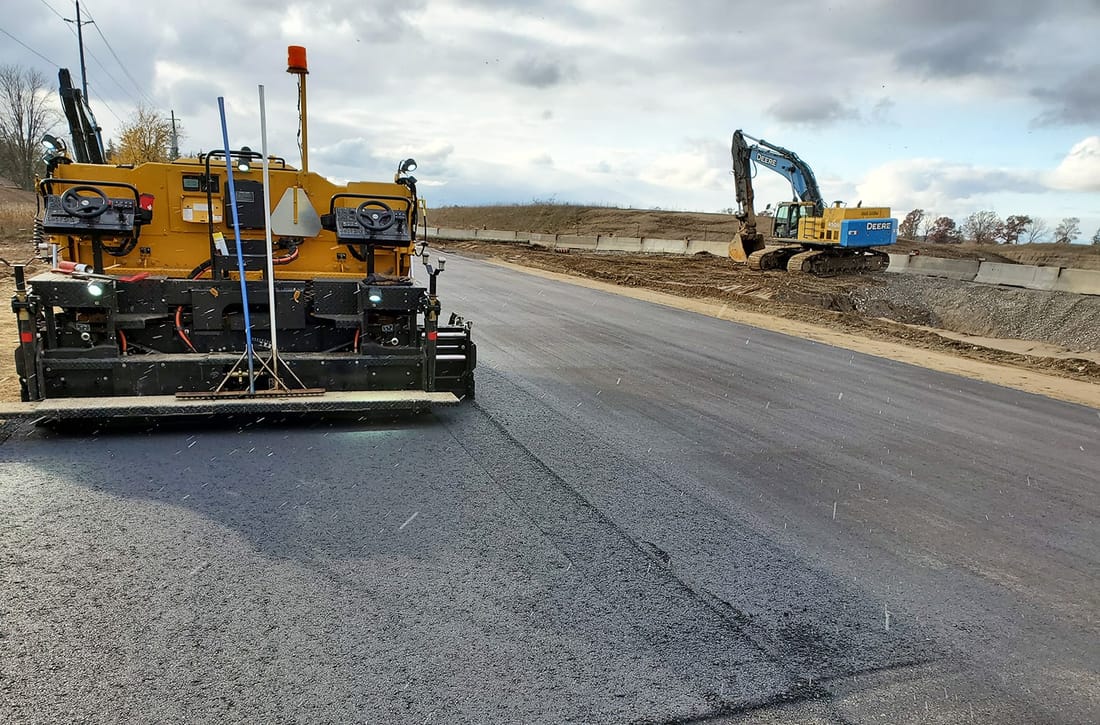
5) Asphalt placement: We typically install a base course and a surface course, using a self-propelled paver for consistent thickness and smoothness. Mix temperature is monitored so compaction can be done within the proper time window. Rollers compact the asphalt in several passes to lock aggregates together and eliminate air voids.
6) Joints, tie-ins, and cleanup: We create clean joints where new paving meets existing pavement, driveways, or intersections, then seal them when appropriate. Corners, manholes, and valves are hand-finished. At the end, we sweep, remove loose millings, and leave the route ready for striping and opening on the agreed schedule.
Material Choices and Asphalt Mixes for Indy Roads
Not every road needs the same asphalt. Precision Asphalt Indianapolis selects mixes and layer thickness to match traffic and budget while still meeting local specifications.
For low-volume residential streets in Indianapolis subdivisions, we often use a dense-graded surface mix over a compacted base course. Typical total asphalt thickness might range from 3 to 5 inches, depending on whether garbage trucks and delivery vehicles are the primary heavy loads. In older neighborhoods where the base can be questionable, we may recommend thicker base asphalt and a geotextile fabric to help control reflective cracking.
Collector roads, industrial park streets, and routes that see frequent semi traffic need more structure. Here, we might design a thicker asphalt section with a stronger base mix, or use a stiffer binder that stands up to braking and slow heavy turning movements. We pay special attention to intersections, loading areas, and bus stops, which often need extra thickness or a modified mix because of standing loads and tight turns.
For municipal resurfacing, we can place standard overlays or leveling courses to correct wheel ruts before installing the final surface. In some cases, we propose mill-and-fill, where the top layer is milled off and replaced with a fresh surface. This can correct drainage and ride quality without the cost of full reconstruction.
We also address winter and freeze-thaw cycling in central Indiana. Mix selection, compaction targets, and joint treatment are all geared toward minimizing water infiltration, which is the primary driver of potholes once temperatures drop and rise repeatedly.
Cost Drivers for Road, Street, and Municipal Paving
Understanding what affects cost helps you plan a realistic budget and compare bids fairly. Precision Asphalt Indianapolis breaks down our estimates so you can see where the money is going.
Project size and layout: Long, straight segments are more efficient than short segments with many intersections, cul-de-sacs, or tight radii. Mobilizing a milling machine, paver, and rollers for a few short blocks costs proportionally more than paving a long continuous stretch, even if total tonnage is similar.
Existing pavement condition: A simple overlay over a sound base is far less expensive than a rebuild that requires undercutting soft subgrade or replacing failed stone base. Roads with alligator cracking, extensive potholes, or visible pumping when trucks pass usually need more extensive base repair.
Thickness and mix type: More asphalt means more cost, and heavy-duty mixes cost more than standard residential mixes. If you want a road that can carry heavier trucks or last longer before the next resurfacing, you will see that reflected in the thickness and material portion of the quote.
Traffic control and phasing: Roads that require police details, complex detours, or night work to avoid disrupting critical operations will cost more than simple flagging on a quiet subdivision loop. Maintaining continuous access to a fire station, school, or medical facility can require creative phasing and extra labor.
Drainage and structures: Adjusting manholes, inlets, and valves, rebuilding sections of curb, and correcting chronic drainage issues add scope and cost but often save money over time by preventing premature failure. We spell these items out so you can prioritize or phase them as needed.
Common Road Problems in Indianapolis and How We Fix Them
Indianapolis roads and streets face a mix of freeze-thaw cycles, clay-rich soils, and varied traffic. Precision Asphalt Indianapolis has seen the same patterns repeat across neighborhoods, and we tailor repairs to the underlying causes rather than just treating the symptoms.
Alligator cracking and potholes: Network cracking that looks like alligator skin usually indicates a structural problem. Patching over the top rarely lasts. We typically cut out and replace these areas full-depth, rebuilding the base and installing new asphalt in layers. For municipal streets with many distressed areas, we may recommend full-depth reclamation, which grinds the existing pavement and base together, stabilizes it, and then paves new asphalt on top.
Rutting and shoving at intersections: Deep wheel ruts, especially at stop signs, intersections, and bus stops, are a sign of inadequate structure or a mix that is too soft for the loads. We mill out rutted lanes, sometimes only in the wheel paths, then place a stiffer mix and restore cross-slope to move water off the travel lanes.
Standing water along the curb: Water that sits along gutter lines or in low spots accelerates pavement damage. Fixing this may involve milling high areas, using a leveling course to correct low points, or replacing small sections of curb and adjusting inlet elevations. We walk the road with you after rainfall when possible to see real drainage behavior before finalizing a plan.
Seam and joint failure: Older Indy streets that have been widened over time often show cracking right where the old and new pavement meet. We address this by cutting back into the older pavement to create a stable joint, tacking thoroughly, and sometimes using fabrics or grids to help bridge the transition. Proper compaction along the joint is critical so the seam does not reopen in a couple of seasons.
What to Expect When You Work With Precision Asphalt Indianapolis
We know that road and street projects disrupt daily routines, so our goal is to make the process predictable and as short as practical without cutting corners. Before any work starts, Precision Asphalt Indianapolis provides a clear written scope, a realistic schedule, and a traffic control plan tailored to your site.
During construction, you receive a single point of contact who can answer questions about phasing, access, and any field changes. For HOAs and property managers, we can provide notice letters or maps that you can send to residents or tenants explaining which sections will be closed on which days, where to park, and how long the asphalt needs to cool before vehicles drive on it.
We coordinate striping, signage, and any needed ADA-related work so the road can open fully and safely, not just be paved. After completion, we review the work with you on site, address any punch list items, and explain realistic expectations for maintenance, such as recommended timing for sealcoating adjacent lots or shoulder grading.
Our approach is straightforward: design the road to fit the traffic it will actually see, control water as well as possible, build a solid base, and compact the asphalt correctly. That is how we deliver road paving in Indianapolis that lasts and keeps maintenance cycles predictable for city departments, HOAs, and private owners.